You are currently browsing the monthly archive for January, 2008.
The summer after I finished fifth grade, Dad retired from the Air Force. After 20 years in the military, he rose only to the rank of staff sergeant, so there was little retirement pay. Dad’s skills in repairing flight simulators weren’t in great demand in the Real World, so he decided to go to college on the G.I. Bill. The college he chose was Washington State University in Pullman–a 5-1/2 hour drive away from our home.
With Dad away at college and no one earning money, Mom had to apply for public assistance. Now, my mother was no stranger to need. She survived World War II in Germany on rations such as one egg per person per month. But during the war, everyone was in the same boat. While Dad was at college, we couldn’t help comparing our poverty to what we perceived to be the riches of everyone around us. Initially, we received USDA commodities, including cans of chicken, milk in plastic bags, and one-pound bricks of butter. We consumed them in our own home, so it was easy to hide our need, but moving on to food stamps “outed” us. Handing food stamps to the cashier at the grocery store was so humiliating for my mother that she burst into tears.
We were also outed at school, where the three of us kids got free lunches. In the cafeteria of my junior high school, a bulletin board depicted a big construction paper fish eating a smaller fish, which was eating a still smaller fish. Underneath were the words, “There’s no such thing as a free lunch,” which only compounded my shame and self-consciousness.
At 12 and 13, my brother and I started delivering newspapers to earn money. Seven days a week, rain or shine, we traveled miles to deliver The News Tribune to the residents of our rural town, Roy, Washington. The town is bisected by railroad tracks, and Tom delivered papers on one side of the tracks, while I delivered them on the other. Mom got a physically demanding job at a tree nursery called Silvaseed.
Although my father eventually graduated from WSU, things never got much better. He worked here and there as a substitute teacher, but was never able to function outside the military. It had told him what to wear, where to go, what to do, when to do it, how to do it, and whom to salute. He couldn’t figure those things out for himself as a civilian. Socially and emotionally, he remained stuck in his early teens.
When I moved on to work-study jobs in high school, my little sister inherited my paper route. I attended Pierce College, and managed to get through on grants, scholarships, and more work-study jobs. Then I transferred to Seattle Pacific University, where I also received grants, student loans, and work-study.
I don’t know if it was not being able to afford a 10 cent postage stamp or a 25 cent load of laundry, but I eventually had one of those Scarlett O’Hara moments. You know, the moment when she collapses on her knees, grabs a fistfull of dirt and says, “As God is my witness, I’ll never be hungry again.”
And that is exactly how my life turned out.
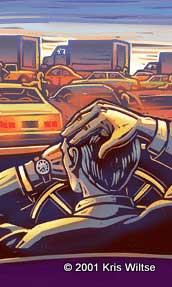
Not having enough money made me feel desperate, stressed, embarrassed, trapped, powerless, and afraid–all definite signs that I was not on my path. When I graduated from college and was able to assume full responsibility for my own destiny, I redirected my course, and things got a lot better.
Kris Wiltse’s illustrations for the “Desperate,” “Stressed,” “Embarrassed,” “Trapped,” “Powerless,” and “Afraid” cards from the Mixed Emotions card deck.
Why? Why, with the Great Outdoors at their disposal do rodents set up housekeeping under the hood of my car and decide that electrical wiring is just the best thing they’ve ever tasted? More than $500 dollars later, we don’t call it “the car” anymore. We call it the “rat buffet.” As in, “Adrian, get in the rat buffet.”
I found no help for this problem online, so thanks to the helpful hardware man at Ace, I submit the following procedure for the general good of humankind.
How to keep rats from eating your car wiring
- Go to your local hardware store and purchase the following:
A roll of twist-tie material. This is usually green, and you can find it in the gardening section.
A box of RatMax Mini-Blocks by Enforcer.
If you don’t have a pair of rubber gloves, get a some of those, too. - Open your hood.
- Cut off a piece of twist-tie material, oh, say, a foot long.
- Put on your rubber gloves.
- Take a block of RatMax, and thread the twist-tie through the hole in the middle. Give the twist-tie a few turns right above the block to keep it from moving moving along the plastic-coated wire.
- Now, fasten it to a spot under the hood that won’t interfere with the workings of your engine. If you’re unsure about where to put it, ask a mechanically inclined friend or your mechanic.
- Hang two to four blocks of RatMax and monitor them regularly.
- When you discover that rats have nibbled one block away, replace it. The manufacturer of RatMax sys to “Maintain a constant supply of fresh bait for 10 days or until signs of rat activity cease.”
I now have rat poison hanging under my hood like Christmas tree ornaments, and the good news is that the rodents have been eating it. I typically avoiod getting into an adversarial relationship with nature, but this? This is WAR.
Having rats eat my car wiring feels frustrating and disgusting, which is how my “internal guidance system” let’s me know that I need to do something about it.
Kris Wiltse’s illustrations for the “Frustrated” and “Disgusted” cards from the Mixed Emotions card deck.
I have wrestled my son to bed for the night, and am sitting on my own bed, ready to do some work on my laptop computer.
“Mama,” he calls down the hall, “I’m sad.”
“About what?” I ask, trying to determine whether this is just another ploy for a “sleep-over” with me.
“I don’t know,” he says.
“Well, your sadness is just a feeling you’re having. It’s a messenger that has some information for you. What is it trying to tell you?”
After a long pause, he says, “Connor gave me a stick and made me hit Tunji with it.” (Tunji is Connor’s dog.)
“I’m your mother,” I say, “and I know how hard it is to get you to do something you don’t want to do. There’s no way Connor made you hit Tunji.”
Long pause.
“So, you’re feeling sad because you hurt Tunji?” I say.
“Yeah,” he said.
“Tunji forgives you,” I say, knowing that he’s just one tail-wagging ball of love and fogiveness. ”Now you need to forgive yourself.”
“How do I do that?” he asks.
“You need to love yourself,” I say.
After a bit, he says, “I still feel sad. Can you tap?”
“Sure,” I say. And after two rounds of tapping, he goes to sleep.
Adrian was born with an instinct to provide and defend by killing, which we don’t really value or create a natural outlet for in the 21st century. Being male, he is the result of thousands of years of natural selection, in which only the best hunters and warriors survived. He loves animals, though, and is often conflicted. One minute he wants to hunt rabbits and deer to provide meat for us, and the next minute, he wants to help a local farmer’s beef cattle escape so they won’t get slaughtered. Sometimes his wires get crossed and he hurts an animal he cares about, such as Tunji.
When Adrian feels sadness and doesn’t know what to do about it, he talks to me. Sometimes, he refers to an undefined jumble of negative emotions as a “clump,” and we sort through it to figure out what he’s feeling and why. This typically happens at bedtime, when he begins to reflect on his day.
Kris Wiltse’s illustrations for the “Sad” card from the Mixed Emotions card deck.
I lived in Seattle for about 20 years, but soon after my son was born, I began to feel the urge to move. This was unusual for me because:
-
My father was in the military while I was growing up, and all I ever wanted was Never To Move Again.
-
My marriage came to an end when my son was 12 months old, so if we moved, we’d be doing it on our own.
-
My support network was in Seattle and moving away from it, especially as a single parent, made no sense at all.
-
My father was very ill, and I was making many trips south of Seattle to visit him and support my mother.
But in the fall of 2001, my father died. Three days later, my divorce was final, and a few weeks after that, I got in my car, drove north, got on a ferry, and started looking at property on Whidbey Island. It took about a year to get my house ready to sell, sell it, buy a new house, pack everything we owned, and move.
What possessed me? I still don’t know. Architect Ross Chapin once told me, “Whidbey is a calling,” and I couldn’t agree more. I was “called” so intensely that I felt like I got caught in a tractor beam.
We’ve lived here six years now, and I’ve spoken to many Islanders who felt just as intensely called, in spite of the fact that it can be challenging to earn a living here. Sometimes, when I’m in Langley, I still can’t believe how wonderful life here is, and I expect a klieg light to fall out of the sky, as it did in the movie, “The Truman Show.” (The idyllic island town that Truman lived in turned out to be a movie set.)
There were so many logical reasons for me not to move to Whidbey Island. But I followed my heart and did it anyway, which just goes to show that I can learn from my mistakes. The rewards are incredible. This place felt like home the moment we set foot on it, and we’ve never been happier.
Before we moved, I felt a sense of longing. I felt receptive and open to the possibility of leaving Seattle, I trusted that moving was the right thing for us to do, and I feel incredibly happy now that I’ve done it.
Kris Wiltse’s illustrations for the “Longing,” “Receptive,” “Trusting,” and “Happy” cards from the Mixed Emotions card deck.